Please support the blog via Swish (Sweden), MobilePay (Finland) or Wise.
In Finland, politicians are calling for entrepreneurial thinking. It raises the question: what is Entrepreneurial thinking?
Biological anthropology and neuro-psychological research together demonstrate that entrepreneurial thinking defines our species. That means that its not something some people have, but that we evolved into that kind of thinking, and that inhibitors in our environment are the only reason people in general are not using these higher order mental qualities.
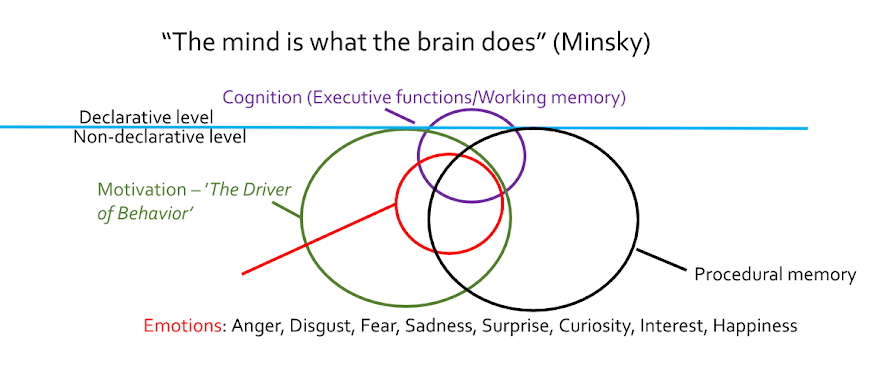
Entrepreneurial thinking, which is about the “knowledge structures” that people use to make judgments and decisions that involve the evaluation, creation and growth of opportunities (Cacciolatti och Lee, 2015; Mitchell et al. 2002; Österberg, 2012), is based on our species' general ability to experience the future (Atance and O'Neill, 2001, 2005; Gilbert and Wilson, 2007), manifested by the action of milking other people of information (Pagel, 2019), or by combining non-related real or mental objects into new distinct categories (Einstein (see Hadamard, 1996); Österberg, 2012, Österberg Köping Olsson, 2018, 2021; Ricord, 1840; Wynn, Coolidge and Bright, 2009), which together form the executive functions – a set of cognitive abilities that allow individuals to plan, organize, guide, regulate, and evaluate behavior forward in time (Ardila, 2008; Atance and O'Neill, 2001, 2005; Barkley, 2001; Coolidge and Wynn, 2018; Elliott, 2003; Galistel, 2017; Gilbert och Wilson, 2007; Kaku, 2014; Lezak, 1982; Liu et al. 2017; Moulton and Kosslyn, 2009; Pluck, Cerone and Villagomez-Pacheco, 2023; Pringle, 2016; Schacter och Addis, 2007; Suddendorf, Bulley, and Miloyan, 2018; Szpunar et al. 2014).
The discovery of the Lion-man shows that our species had the ability to combine non-related real or mental objects into new distinct categories ~40 000 years before the present.
 |
| The Lion-man. Photo: Chris Osburn Link to source. |
I have developed models which influence or facilitate entrepreneurial and combinatory thinking:
-
Organizational learning. It has a three-dimensional structure, based on theories of Communication, Goal-setting, and learning style, as has been tested statistically (Österberg, 2002).
-
Generative learning management – a two-factor model for leadership that affects work climate, generative learning (Peter Senge-style) and social creativity within organizations (Österberg, 2004, 2012).
A statistical test confirms the proposition that leaders should emphasize two things: goal-assignment and decentralization of decision making to attain the goal to the level of operations.

- Rational entrepreneurial thinking (Österberg, 2021) – a three-dimensional model, based on epistemic vigilance (Sperber et al. 2010), numeracy, and disjunctive reasoning (Shafir, 1994; Toplak and Stanovich, 2002), that I suggest influence epistemic and instrumental rational prospective thinking.

A leader who applies these models will see an impact on organizational performance, learning, and social creativity for problem solving.
 |
| (Copyright) Peter Österberg (2024). |
Usually these kinds of processes are referred to as problem solving. But a problem is not situational but a difference, between a current state and a goal-state (intentional prospect) (Duncker, 1945). That implies that if you don't have come up with an intentional prospect (goal), you don't have a problem. But before elaborating intentions forward in time, it makes sense to start with the current state.
When the current state is defined, then the rather extensive work starts to figure out and formulate what you want to attain. That target/goal is then communicated/assigned to the organization. For example, if you are obese, have high blood pressure, or have mental health issues, the targets may be: a waistline which equals your height minus 100, stable blood pressure, and the ability to activate your goal-oriented executive functions.
Current state for Finland. According to public records, the current state for Finland is the following:
- October, 2020. There are ~100,000 poor children in Finland (Finnish media).
- November, 2020. Finland has a child obesity epidemic (Eva Roos, Folkhälsan) .
- February, 2022. Helsingin Sanomat reported on challenges with the working climate at the University of Helsinki (Parikka, HS)
- March, 2022. Nutritional deficiency. Many Finns have been convinced to reduce their consumption of butter and salt (THL).
- April, 2022. Women's relational aggressiveness (psychological domestic violence) is the major challenge (Helsingfors Police Department).
- May 14, 2022. Too many Finnish children fail in reading comprehension and numeracy – the foundation for epistemic and instrumental rational thinking (Stanovich, 2011, 2016) (Ministry of Education and Culture). Why? see point 2.
- September 3, 2022. Finland has lost 600,000 simple jobs (Skinnari, Finland's minister of Development).
-
September 5, 2022. Li Andersson, Finland's secreatary of education and culture, points out that involuntary school absences have increased in recent years and that anxiety or depression is often the underlying cause (Söderlund, Yle, 2022).
- October 22, 2022. Finland has the highest rate of Alzheimer's/dementia in the world (Österberg, 2022).
-
October 25, 2022. Between 2007 and 2022, Finland had a budget deficit (losing money every year); Sweden had a budget surplus (earning money every year)
-
November, 2022. 20% of children and adolescents born in 1997 or later have mental health challenges (Pekkarinen, Finnish-Swedish Children's Rights Days (Finlandssvenska Barnrättsdagen).
- Finland's economy has been running a deficit for the past 15 years (Harald, HBL, 2022).
- February, 2023. Swedish-speaking Finns have better health and live longer (City of Helsingfors, at Arbis).
- April 11, 2023. The functional capacity of Finns is deteriorating (Helsingin Sanomat).
- August 3, 2023. Research at the University of Helsingfors has, and I quote, collapsed (Bäckgren, HS).
- Finland has the highest incidence of Alzheimer's/dementia in the world:
“The country with the highest incidence of Alzheimer’s disease is Finland. There are 54.65 cases of Alzheimer’s per 100,000 people in the country. These figures and statistics place Finland in the extremely high range for incidence and prevalence of the disease. Interestingly, women are much more likely to get Alzheimer’s in Finland than men. For every 100,000 people, Alzheimer’s affects 55.32 women compared to just 52.10 men” ( WPR
- Finland's Alzheimer's rate is twice as high as in neighboring Sweden:
19.9% of Finns who die of dementia, and in particular Alzheimer's disease.

Prevalence of welfare diseases in Finland.
Among Swedes who die, 9.8% die of dementia/Alzheimer's.

Prevalence of welfare diseases in Sweden.
- November, 2023. Psychological domestic violence (relational aggression) and fatal violence against young children have increased (Pekkarinen, Finnish Children's Commissioner, at the Finnish-Swedish Children's Rights Days). Why? see point 2.
- November, 2023. There are ~130,000 poor children in Finland (Finnish researcher at the Finnish-Swedish Children's Rights Days). That is an increase of 30% from 2020.
- November, 2023. Finland has the highest prevalence of depression within the EU (Estlander, Bensow, at the Finnish-Swedish Children's Rights Days).
- November, 2023. 40% of Finnish schoolchildren are victims of psychological domestic violence (Estlander, Bensow, at the Finnish-Swedish Children's Rights Days). Psychological violence at home = relational aggression, is typically female.
- February 13, 2024. Finland's national debt/GDP: 74%; Sweden's national debt/GDP: 17% (Ingves).
- February 28, 2024.the working climate in Finnish workplaces is poor (Yle).


- I have successfully helped individuals and organisations to formulate goals to facilitate performance, and entrepreneurial thinking.
- I am in Finland because I am an expert beyond the ordinary.
- I now offer courses, lectures and executive coaching.
Read: An introduction to Peter Österberg, Ph.D. including links to my offers, and my CV.
Please support the blog via Swish (Sweden), MobilePay (Finland) och Wise.
More about my expertise:
Executive coaching for CEOs/managers and workshops to facilitate Organizational Performance, Learning, and Creativity for Problem Solving | Lectures: Nutrition for physical and mental health | Course/lecture: children's emotional and social adjustment and cognitive development | Language training - Swedish | Academy Competency | CV | Teaching skills and experience | Summary of research project | Instagram | Linkedin | YouTube-channel | TikTok | X
No comments:
Post a Comment