Please support the blog via Swish (Sweden), MobilePay (Finland) or Wise.
A recent study – Dwairy (2018) – argues that culture should be the guiding light in schools.
If culture is a set of norms, values, and directieves that guide people on how to behave and manage their lives, then culture is a form of unidentified leadership. For intance, culture directs people to relinquish the self and save the harmony and name of the family, while individuslistic culture encourages freedom and self fulfilment. This defintion fits one of the characteristics of good leadership as defined by the ancient Chinese phiosopher Lao Tzu: A leader is best when people barely know he exists, when his work is done, his aim fulfilled, they will say: we did it ourselves.Academic leadership differs in many ways from other activities in that the decentralization is so tangible. Universities are expected to research, teach and carry out the so-called third task – to bring new and validated knowledge to the people (like this science blog). This motivates tax-funded research. The cultural aspects that influence the process are based on heterodoxy, 'high ceilings' and Knowledge heterogenity.
Since the establishment of the University of Bologna (12th century), masters and doctors (not to be confused with physicians), sometimes also called professors, have been responsible for the cultivation of academic knowledge and culture. Students have hired masters/doctors/professors to lecture them and thereby influence the students' personal development.
This culture has laid the foundation for what we today call the knowledge society, where humanism, reason and science are prioritized over honor culture and tribal thinking (Pinker, 2018). This system has also been highly decentralized.
The effect was that long-standing ideas such as emanation – that higher-order knowledge radiates from a higher unknown entity to certain chosen ones – were replaced with ideas linked to the respective functions of the brain and the mind.
This opened the door to exciting experimental designs and models. One such model is the theory of evolution (Darwin, 1859; Wallace, 1859). Darwin and Wallace were probably not the first to come up with the idea, for example Alexander Bain (1818 – 1903) formulated Blind Variation and Selective Retention (BVSA) (Bain, 1855; Simonton, 1999) which in its design is reminiscent of the theory of evolution. BVSA was used by Campbell (1960) to describe the cognitive process we today call creativity. But Bain was not the first. Remember Elizabeth Ricord (1788 – 1865) om imagery:
“The highest development of the Intellect is in the power it has of combining its conceptions, so as to form creations of its own; a world within itself. This is the province of Imagination” (Ricord, 1840, p. 284).It also means that the individual's ability to understand concepts and their interrelationships (Terman och Oden, 1947) changed. A crucial factor in this development is the environment you are braught up in. The earlier the individual is introduced to reasoning, i.e. the exchange of ideas through language, the (Pinker, 2011), the greater the effect on cognitive development which is manifested in the individual's school performance and personal development later in life.
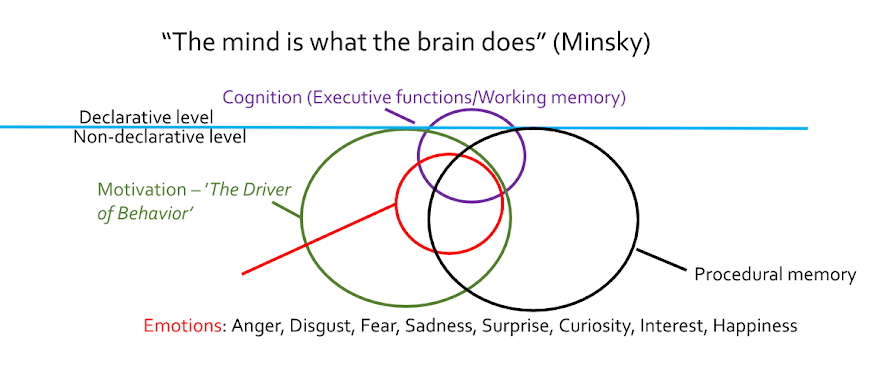
Central to the mental development of our species is something called executive functions (Ardila, 2008, Ardila et al. 2018; Adornetti, 2016; Barkley, 2001; Coolidge and Wynn, 2018; Goldstein et al. XXXX; Tomasello et al. 2005). These can be divided into emotional and social adaptation as well as cognitive development.
The foundation for children's emotional and social adaptation as well as cognitive development is laid during the first years of life (Gopnik, 2016):
“But in fact, schools are a very recent invention. Young children were learning thousands of years before we had ever even thought of schools. Children in foraging cultures learned by watching what the people around them did every day, and by playing with the tools they used. New studies show that even the youngest children’s brains are designed to learn from this simple observation and play in a remarkably sensitive way.Baumrind (1996) shows that children who experience reciprocal authority in the communcation with their parents, around the age of 4 have better emotional and social adjustment and cognitive development compared to children who experience control and a let-go attitude.
Young children today continue to learn best by watching the everyday things that grown-ups do, from cleaning the house to fixing a car.”
Hart och Risley (1995) shows that children who experience an academic conversational climate at home during the first three years of life gain 30,000,000 word perceptions compared to children who experience a command-and-control mentality.
Arden, Trzaskowski, Garfield & Plomin, (2014) shows that 4-year-olds who can draw a human-like figure with 10-12 details on command perform better in school at the age of 12.
It's good that the father is home with the children (LaFlamme et al. 2012; Lamb, 2010). A research team at Imperial College has published a study showing that children who interact with their fathers at three months of age have better cognitive abilities at the age of two (Sethna et al. 2017). A systematic review shows a positive effect of father-child relationships on schoolchildren's cognitive development (Rolle et al. 2019). The father-relationship benefits children's emotional and social adjustment (Vieno et al. 2009, 2014). My own master's thesis in social psychology, which deals with children's emotional relationships with their respective parents, indicates that children who grow up with both parents or only with their father have better emotional and social adjustment and cognitive development (including visuospatial perception and numeracy) compared to children who grow up with only their mother (Österberg, 2004):
“A review of 28 studies on the effects of father absence on children's cognitive ability (Shinn, 1978) indicates that father absence as a function of divorce is negatively related to intellectual competence in children; this has also been demonstrated in previous studies (Blanchard & Biller, 1971; Crescimbeni, 1965; Ferri, 1976; Hetherington et al., 1978, 1982; Radin, 1976; Radin et al., 1994; Santrock, 1972; Sutton–Smith et al., 1978). Shinn (1978) argues that the results of the review are consistent with the hypothesis that children's interaction with their parents forms a platform for cognitive development, and that a reduction in this interaction inhibits cognitive development ” (p. 2).
“En sammanställning av 28 undersökningar om pappa-frånvarons effekter på barns kognitiva förmåga (Shinn, 1978), indikerar att pappa-frånvaro som en funktion av skilsmässa är negativt relaterad till intellektuell kompetens hos barn; vilket även påvisats i tidigare studier (Blanchard och Biller, 1971; Crescimbeni, 1965; Ferri, 1976; Hetherington et al., 1978, 1982; Radin, 1976; Radin et al., 1994; Santrock, 1972; Sutton–Smith et al., 1978). Shinn (1978) menar att resultaten av sammanställningsstudien är konsistent med hypotesen att barns interaktion med föräldrarna formar en plattform för kognitiv utveckling, och att en minskning av denna interaktion hämmar den kognitiva utvecklingen” (s.2).Over generations, the intelligence quotient (IQ) of the typical individual has increased through the so-called Flynn effect:
“An average teenager today, if he or she could time-travel back to 1950, would have an IQ of 118. If the teenager went back to 1910, he or she would have an IQ of 130, besting 98 per cent of his or her contemporaries (Steven Pinker (2011). The Better Angels of Our Nature” ..., in Tom Chivers (2014). The Flynn effect: are we really getting smarter?, Telepgraph).Ergo. Academic leadership is inherited from parents whose parenting style lays the foundation for children's emotional and social adjustment and cognitive development – executive functions. It includes activities such as reasoning – the exchange of ideas through language – winning if there is a divergence of opinion (Haidt, 2012), i.e. what is usually called “high ceilings”. (Ekvall, 1996; Österberg, 2012). Wise school leaders take this into account.
Please support the blog via Swish (Sweden), MobilePay (Finland) or Wise.
More about my expertise:
Executive coaching for CEOs/managers and workshops to facilitate Organizational Performance, Learning, and Creativity for Problem Solving | Lectures: Nutrition for physical and mental health | Course/lecture: children's emotional and social adjustment and cognitive development | Language training - Swedish | Academy Competency | CV | Teaching skills and experience | Summary of research project | Instagram | Linkedin | YouTube-channel | TikTok | X
No comments:
Post a Comment