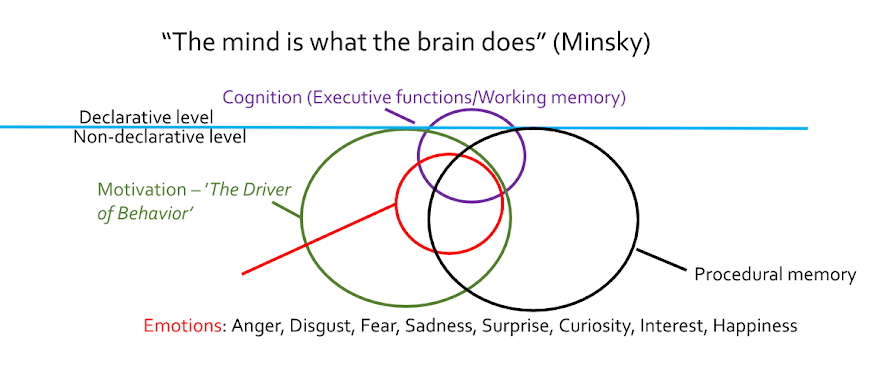
After I was recruited to the University of Helsinki I have attended numerous conferences about entrepreneurship, innovation, and AI. They all seem to lack fundamental knowledge about how the mind works, for example executive functions and theory of mind.
Please support the blog via
Wise..
Yesterday was a double conference day; entrepreneurship in Esbo, and AI in Helsingfors. And I believe entrepreneurial thinking and AI has a common denominator – how the mind works. (As a research psychologist, I may be a bit biased.)

Here’s one catch. The conference space and the networking in Esbo was great, and we had lots of interpersonal verbal exchanges in a reasoning fashion. But the presentations were not made in English or Finland’s and Sweden’s common trade language (9th century –), but the Uralic language which Russia is said to have imposed during their occupation of the former eastern part of the Swedish kingdom (1809 – 1917).
Here are other convergent catches, which I learned about in my role as a researcher, traveling to conferences around the world, listening to how people talked about Sweden, and what the historical record reveals.
The short version. Over the past 3,000 years, Sweden, its predecessor Svitjod, and what came before that, have been characterized by something called exogamy, which in my opinion is synonymous with something I've researched: – entrepreneurial thinking – “knowledge structures” that people use to make judgments and decisions that involve the evaluation, creation and growth of opportunities (Cacciolatti och Lee, 2015; Mitchell et al. 2002; Österberg, 2012).
Sometime during the 9th century, chieftains in Satakunda on the eastern side of the Gulf of Bothnia, applied to become part of Svitjod’s mighty trading network. That started an integration (Klinge, 1985); entrepreneurial thinking spread and became dominant around the Gulf of Bothnia, and also, around the Baltic sea.
28 trade posts were founded in the eastern part of Svitjod/kingdom of Sweden, as well as an annex to Uppsala university (1477 –) – the Royal Academy in Åbo, later to become the university of Helsingfors.
But here’s another catch. According to Finnish Sitra, Finland's entrepreneurship and innovative thinking is at rock bottom. They also ask: – why is Sweden doing so well?
Well, common knowledge in anthropology has changed. Back in the day, most scholars believed that agriculture carries culture, but now, common knowledge is that language carries culture (Cavalli-Sforza, 1997; Pagel, 2009; Reich, 2019), and in Sweden, the trade language which brought entrepreneurial thinking to the eastern part of the kingdom is still dominant.
But 568 years after Holmgård (Novgorod; later to be Russia (1547 – )) declared independence from Svitjod, Russia invaded the eastern part of the Swedish kingdom. And after >50 years of occupation, Alexander II (A2; 1818 – 1881) imposed a second language to suppress the trade language.
But A2 didn't choose his own language, which would have made sense from an instrumental rational thinking point of view, but instead, he opted for one of the Uralic languages which was spoken in different ways by tribes in the northeast of Fennoscandia.
According to different Finnish sources (scholars in the realm of humanism, especially history), the Uralic language reached break-even ~1925 (plus/minus 15 års; one source said 1910 and the other 1940), that is eight years after the declaration of independence from Russia and the republic of Finland. That coincided with the language strife; uralic-speaking children attacked children who remained in the entrepreneurial culture.
The Kremlings' biblical oriented soft-power-approach to split the people living around the Gulf of Bothnia turned out to be really successful. But it came with a high cost for the people living on the east side of the Gulf.
Again. According to Finnish Sitra, Finland's entrepreneurship and innovative thinking is at rock bottom – why is Sweden doing so well?
Here’s the whole list with Finnish challenges (n=41) which has been reported by Finnish government arms and organizations (Österberg, 2025).
At the AI-conference we watched a movie about Demis Hassabis, and his life journey, starting with chess playing at an early age, and peaking with the founding of Deepmind, a software company with the ambition to solve all scientific problems.
The people at Deepmind have been very successful in solving chess-like puzzles, as well as something which had haunted biologists for ~50 years, the Protein folding Problem.
But even though they were and are crowned top thinkers, they failed to solve the Sars-Cov (2) situation, and it's not clear if their software can mimic the mind when the future is uncertain, like in a poker game.
After I was recruited to the University of Helsinki I have attended numerous conferences about entrepreneurship, innovation, and AI. They all seem to lack fundamental knowledge about how the mind works, for example executive functions and theory of mind.
Please support the blog via Wise.
More about my expertise.
Executive coaching for CEOs/managers and workshops to facilitate Organizational Performance, Learning, and Creativity for Problem Solving | Lectures: Nutrition for physical and mental health | Course/lecture: children's emotional and social adjustment and cognitive development | Language training – Swedish | Academy Competency | CV | Teaching skills and experience | Summary of research project | Instagram | Linkedin | YouTube-channel | TikTok | X
No comments:
Post a Comment