Please support the blog via Swish (Sweden), MobilePay (Finland) or Wise.
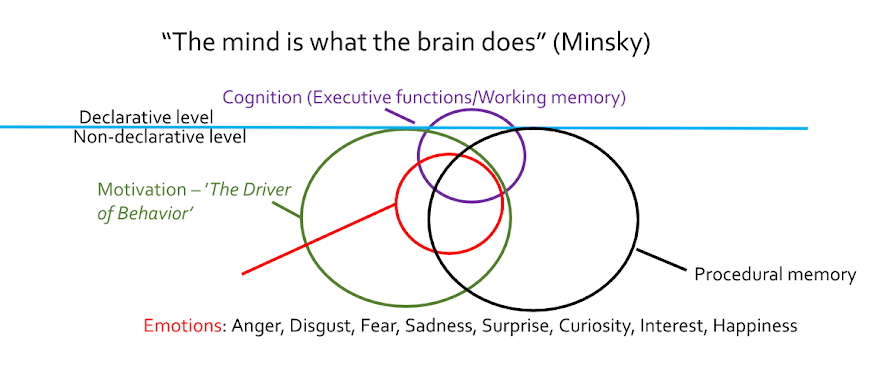
The human mind is what the brain does, and it’s a complex interplay between, on the one hand, non-declarative mental processes like motivation, emotions (plural), and most of human cognition, and on the other, declarative cognitions.
Simplified, the declarative part is represented by the Executive functions, a plethora of ~15 subsets like:
“metacognitive executive functions”: problem solving, planning, concept formation, strategy development and implementation, controlling attention, working memory, and the like; that is, executive functions as they are usually understood in contemporary neuroscience; and (2) “emotional/motivational executive functions”: coordinating cognition and emotion/motivation (that is, fulfilling biological needs according to some existing conditions) (Ardila, 2008).Included in the EFs, or intertwined, is prospective thinking, that is, the ability to use memory and perception to experience the future by elaborating intentions and scenarios forward in time (Atance and O'Neill, 2001, 2005; Barkley et al. 2001; Galistel, 2017; Gilbert och Wilson, 2007; Gallistel, 2017; Kaku, 2014; Lezak, 1982; Liu et al. 2017; Moulton and Kosslyn, 2009; Pluck, Cerone and Villagomez-Pacheco, 2023; Schacter och Addis, 2007; Suddendorf, Bulley, and Miloyan, 2018; Szpunar et al. 2014).
At least two factors are crucial for this interplay to work properly:
- early upbringing (first 4 years of living).
- nutritions, >30 micronutrients, tryptophan, choline, and animal source omega 3 fatty acids, like DHA and EPA.
“A compilation of 28 studies on the effects of father absence on children's cognitive ability (Shinn, 1978) indicates that father absence as a function of divorce is negatively related to intellectual competence in children; which has also been demonstrated in previous studies (Blanchard & Biller, 1971; Crescimbeni, 1965; Ferri, 1976; Hetherington et al., 1978, 1982; Radin, 1976; Radin et al., 1994; Santrock, 1972; Sutton–Smith et al., 1978). Shinn (1978). The results of the comparative study are consistent with the hypothesis that children's interaction with their parents forms a platform for cognitive development, and that a reduction in this interaction inhibits cognitive development” (p.2)”.Humans’ need to consume >30 micronutrients, tryptophan, choline, and animal omega 3 fatty acids, like DHA and EPA from the same plate on a regular basis (Österberg, 2019; 2020, 2021 a, b; 2022, 2023).
So what happens when these two factors fail?
Most physical and mental health issues emerge, I think, because of mental fallacies. This is also known as dysrationalia or natural stupidity. Due to social impact, we tend to rely on information which is prototypical, available, and easy to access. For example,
- Fat makes us fat, because fat on the plate is prototypical to fat on the body.
-
Legacy media reiterate that the World is on the brink of doom.
- Men are blamed for domestic violence.
- 1950 Doroty Miller (1990-1992), who claimed that the world will be consumed by a flood (Festinger et a. 1956).
-
1950 - 1980. Diet-heart hypothesis, and dietary guidelines (Teicholz, 2023).
- 1990 - Sweden recruited a Norwegian feminist who claimed that only men are perpetrators of domestic violence (Bergkvist, 2002).
-
get obese by consuming sugar, and ultra-processed alternatives to real food.
-
The World, overall, in better shape than ever.
- Domestic violence is typically a female phenomenon (references in this science blog).
More about my expertise:
Executive coaching for CEOs/managers and workshops to facilitate Organizational Performance, Learning, and Creativity for Problem Solving | Lectures: Nutrition for physical and mental health | Course/lecture: children's emotional and social adjustment and cognitive development | Language training - Swedish | Academy Competency | CV | Teaching skills and experience | Summary of research project | Instagram | Linkedin | YouTube-channel | TikTok | X
No comments:
Post a Comment