Please support the blog via Wise.
In a collaboration between researchers in design and neuroscience, they set out to find which brain activity was associated with creativity (Saggar et al. 2015). The study was brought to the attention of Katie M. Palmer who wrote about the study in Wired (Palmer, 2015).
“A study out of Stanford today – a collaboration between its design school and its brain sciences research center – used the method to search for brain activity associated with visual creativity. Their test? Sticking subjects into a magnetic resonance tube while they played Pictionary”.Part of the study's premise was that creativity is place-specific, and the researchers' definition of creativity was: – the ability to create new but appropriate results.
The criticism of the study was that the design was not tight; the test control was not representative and that the cerebellum is rather to be considered a coordinating function. Another aspect of the criticism of Saggar et al. 2015 concerned the absence of a network perspective:
“If you took some article from between 2000 and 2005 versus the last 5 years and compared how much they used region and area-focused vs. network, there’s so much more network now”.My thought is that the definition of creativity used led the researchers in the wrong direction. The ability to create new but appropriate results is quite abstract, allowing for almost anything to fit in. Had the researchers used a more stringent definition, then the design would likely have been different. It is also likely that oxygenation in the brain might have been more distributed.
Proponents of the neuroscientific theory point to cerebellum as the central authority. My response is Brainwashed: The Seductive Appeal of Mindless Neuroscience Satel och Lillienfeld's (2013), as well as my own research.
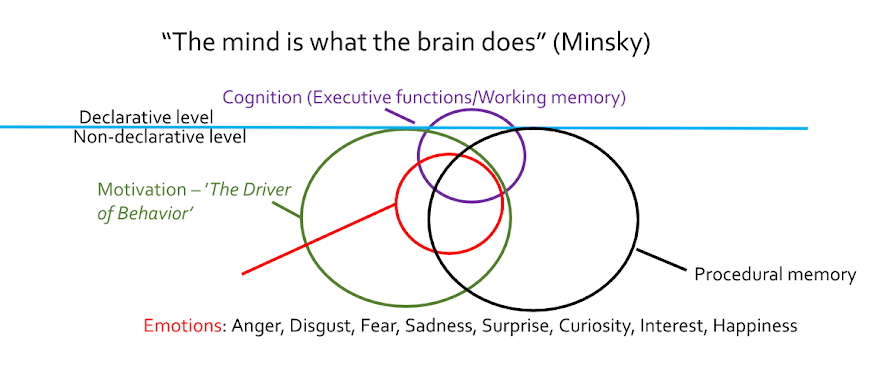
I suggest that creativity is an innate mental ability defined as a mental process in which unrelated knowledge objects, or fragments thereof, are combined or melded into new cognitive structures with meaning, which is explained by a parallel distributed interaction, a 'generative dance', between declarative and non-declarative memory instances (Finke, 1996; Madore, Gaesser, and Schacter, 2013; Madore, Addis, and Schacter, 2015; McCelland och Rumelhart, 1985; Österberg, 2012 a; Pringle, 2013; Schacter, 1987; Schacter och Addis, 2007; Seger, 1994; Wynn, Coolidge och Brigth, 2009).
I elaborated on this in two previous articles; on the one hand as a neurological versus psychological phenomenon and (Österberg, 2013), on the other, place-specific versus a distributed phenomenon (Österberg, 2015).
Our species uses creativity in a social perspective to solve complex problems. And because a problem is the difference between a current state and a goal state, a goal is required (Duncker, 1945; Gilbert and Wilson, 2007; Locke och Latham, 2002; Szpunar et al. 2014).
Although creativity is an innate ability, it may take a little encouragement to get that type of thinking going, e.g. by dancing.
In 2012 I was invited to be a keynote speaker at the Science Festival in Gothenburg. For that purpose I designed a test where subjects were tasked with combining two letters into symbols that represented something useful. One group had to sit still for two lessons before taking the test. The other group had to dance disco for 25 minutes before the test. The results showed that those who danced produced 57% more ideas compared to those who sat still (Österberg, 2012 b).
Please support the blog via Wise.
More about my expertise:
Executive coaching for CEOs/managers and workshops to facilitate Organizational Performance, Learning, and Creativity for Problem Solving | Lectures: Nutrition for physical and mental health | Course/lecture: children's emotional and social adjustment and cognitive development | Language training - Swedish | Academy Competency | CV | Teaching skills and experience | Summary of research project | Instagram | Linkedin | YouTube-channel | TikTok | X
No comments:
Post a Comment